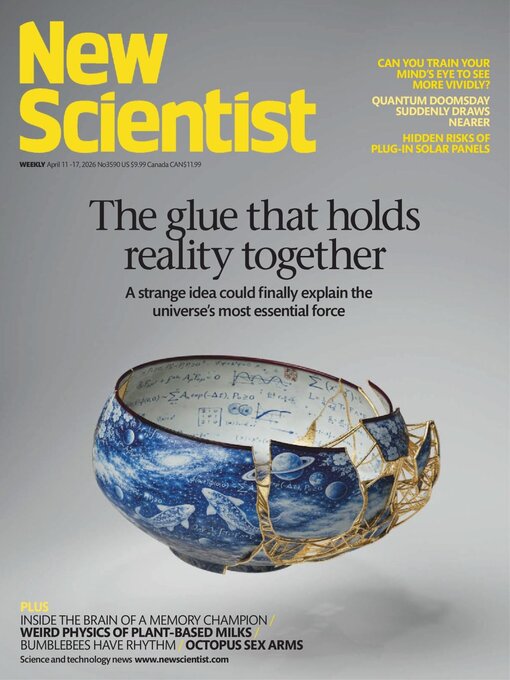
 Apr 11 2026
 Apr 04 2026
 Mar 28 2026
 Mar 21 2026
 Mar 14 2026
 Mar 07 2026
 Feb 28 2026
 Feb 21 2026
 Feb 14 2026
 Feb 07 2026
 Jan 31 2026
 Jan 24 2026
 Jan 17 2026
 Jan 10 2026
 Jan 03 2026
 Dec 27 2025
 13-26 December 2025
 Dec 06 2025
 Nov 29 2025
 Nov 22 2025
 Nov 15 2025
 Nov 08 2025
 Nov 01 2025
 Oct 25 2025
New Scientist covers the latest developments in science and technology that will impact your world. New Scientist employs and commissions the best writers in their fields from all over the world. Our editorial team provide cutting-edge news, award-winning features and reports, written in concise and clear language that puts discoveries and advances in the context of everyday life today and in the future.
The clock is ticking • We urgently need to prepare for quantum computers that can break encryption
New Scientist
Is this when complex life began? • Fossils dating back 554 million years could force us to reconsider when and how animal life first evolved, reports James Woodford
A view of the moon as Artemis II astronauts complete flyby
Eye disease jumps from marine life to people
How to become a memory champion • Brain scans have taken us inside the mind of a man with extraordinary recall, potentially showing us how we could improve our own memory, finds Alakananda Dasgupta
The first quantum computer to break encryption is now shockingly close
Finding the universe’s first stars • A galaxy that existed just 400 million years after the big bang appears to contain extremely pure and young stars, discovers Alex Wilkins
We may have seen a ‘dirty fireball’ star explosion for the first time
Novel way to clear brain waste shows promise for Alzheimer’s
Rhythmic bumblebees give scientists a buzz
Putting plug-in solar to the test • Plug-in solar panels are a cheaper, simpler alternative to professionally installed panels. But can they really reduce energy bills and are they safe, asks Matthew Sparkes
Male octopuses have an arm they mostly use for sex
Plant-based milks flow in an unusual way
All-in-one antiviral fights colds and covid
Dispute over cause of Roman retreat • A proposed explanation for the Romans’ withdrawal from Britain, based on a study of tree ring data, is now being questioned by historians, discovers Michael Marshall
We’re learning more about long covid • Antibodies going rogue and attacking healthy tissue seems to be behind some cases of long covid, a discovery that could bring us closer to finding a treatment, finds Michael Marshall
The mystery of Mars’s missing water runs deeper than we thought
Record data transfer lays the groundwork for a faster internet
What kind of olive oil is best for the brain? • The science suggests olive oil can help us fight cognitive decline, but Helen Thomson finds that only works if we choose the right kind
How Anthony Leggett tested the edges of the quantum world • Karmela Padavic-Callaghan remembers their personal connection with a giant of quantum physics
In formation
Three more great books on inheritance and change
To mutate is human • A fresh and important book reveals the messy reality of our ever-mutating cells – and why the drive to defeat ageing is futile, finds Michael Le Page
New Scientist recommends
Like us, but not • Two smart new sci-fi novels feature robots in richly realised worlds. One of the authors takes a more light-hearted path, while the other follows its robots into danger and darkness, says Emily H. Wilson
Your letters
Reality’s glue • We are finally homing in on how the force that binds the heart of atoms together really works, discovers Michael Brooks
Two for the price of one
Think of an apple • Some of us can imagine objects so vivid they seem real, while others see nothing at all. Is it possible to change? Shayla Love investigates
“I wrote down a simple formula. Then I sat down to see the room erupt” • Twenty years ago, physicist John Pendry unveiled how to create a working invisibility cloak to the world. He...